
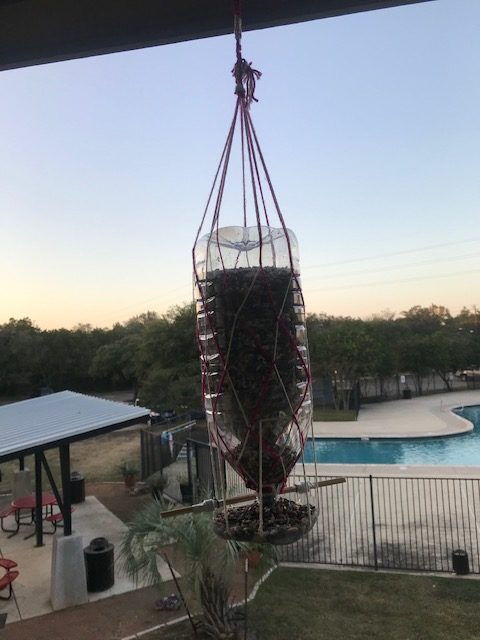
from Celina-Marie Kuehne /
This project aimed to save nature that is, to take some things that are usually thrown away and create something new from them. Preferably it should be something that supports nature.
So I decided to make a bird feeder out of empty water bottles.
What you need:
– 2 plastic bottles
– scissors
– a saw
– drill
– pencil
– ruler
– string
First, I cut off the top and bottom of a water bottle.
Then I made a simple macramé pattern out of the strings and connected it to the top of the bottle.
Next, I cut the top off the second bottle (but only a little). Finally, I drilled holes in the sides of the bottle to attach it to the bottom of the first bottle.
Now we have a homemade bird feeder on our balcony, which is not a second time. And when it gets cold, hopefully, many birds will be found, which I can then watch.
What I learned:
During my research for this project, I learned a lot about the pollution of the oceans with plastic waste and that it is important to do something about it. In our class, we researched this and drafted a fictional letter to a government representative.
Letter to a Representative:
The acidification of the oceans has a significant impact on the future development of nature and thus also on the further development of humanity.
In this text, you will learn about the current ocean acidification.
What is ocean acidification? Ocean acidification is the permanent decrease in ocean pH caused by the uptake of carbon dioxide from the atmosphere. Since seawater is actually slightly alkaline, ocean acidification causes the pH to shift into the acidic range.
Ocean acidification has dramatic effects on marine life by reducing the availability of carbonate ions in seawater. These vital building blocks are needed by organisms to build their muscles and skeletons. If these carbonates are lacking, the chances of survival for the offspring of multiple animals are significantly reduced.
The oceans absorb significant artificial carbon dioxide (CO2) emissions. About one-third of the total emissions come from burning finite fossil fuels, cement production, and land-use changes over the past 200 years. The resulting ocean acidification is having a lasting impact on marine life. This causes the shells and skeletons of organisms to break down from calcium carbonate. The more acidic the ocean, the faster the shells dissolve.
Ocean acidification also affects humans! This essentially affects the food we eat every day, as most shellfish need calcium carbonate to form or strengthen their shells. Many of the fish we eat also rely on shellfish as a food source, so the entire food chain is at risk!
I believe the best way to limit ocean acidification is to respond immediately to climate change and find solutions to drastically reduce fossil fuel use. If we reduce our emissions from global warming and limit future warming, we can significantly reduce the damage not only to our marine ecosystems.
Dramatically reduce our emissions from global warming and limit future warming. We can significantly reduce the damage to our marine ecosystems. Scientists have now found solid evidence that we can. They have demonstrated that ocean acidification has a significant impact on an Antarctic marine snail (Limacina helicina antarctica) in its natural habitat. The ocean absorbs a significant portion of carbon dioxide emissions. This benefits society by slowing climate change. However, this fact is causing these unprecedented changes in ocean chemistry that are lowering the pH of the water and leading to a number of chemical changes. These changes are collectively referred to as ocean acidification. Like climate change, ocean acidification is a global problem that will worsen as CO2 emissions continue and therefore has the potential to negatively impact marine ecosystems sustainably and negatively impact the benefits of the past.